Investment Team Handelsbanken Wealth
15 May 2026 10
This website and all the information provided on it is intended for users domiciled in the UK only. By continuing you are confirming that you have read the important information and understood the legal information contained within. You are also consenting to the use of cookies on this site.
From the growth of AI, and the global power transition that must accompany it, to the rise of electric vehicles and the alarming boom in defence spending, there’s nothing in today’s digital world that doesn’t rely upon metals.
After a record run in 2025, the onset of the Iran war triggered a painful sell-off for gold; it suffered worse losses than most stock markets. This suggested that the yellow metal had come untethered from its previous drivers, sacrificing much of its diversification benefits in the process.
At the same time, there are a number of once-in-a-generation, fundamental drivers that have transformed the outlook for industrial metals and the companies that mine them. But even though our digital world is entirely dependent on a varied diet of critical metals, the global mining industry remains fundamentally ‘under owned’.
We think this makes a compelling case for reducing our exposure to gold in favour of a new position in global mining stocks which, unlike gold, are driven by fundamentals and cashflows recorded on company balance sheets. Investing in miners might carry more volatility than broader stock market investment, but we think it’s worth shouldering due to the five clear fundamental tailwinds that look set to support metals and mining stocks for decades to come.
1. The AI buildout
The massive buildout of AI datacentres, and the huge amounts of energy they require, has become a key driver of metals demand.
OpenAI is just one example of the Herculean energy requirements of the AI buildout. It plans to bring 30 gigawatts – meaning 30 billion watts – of ‘compute’ infrastructure online (namely the hardware processing power needed to train, run, and scale AI) to support its growing family of AI models.
The birth of AI is also set to make the internet far more energy intensive. While today’s internet accounts for around 1.5% of global energy demand, this is forecast to quadruple in the next 10 years with AI queries alone expected to account for c3% of global energy demand by 2045.
The nuclear option
AI’s enormous appetite for energy is such that since late 2024, four of the US hyperscalers, Amazon, Alphabet (Google), Meta (Facebook) and Microsoft, have embarked on massive investment into nuclear plants, breathing new life into the sector and taking nuclear energy stocks to new record highs.
Each has signed multi-decade deals, either to bring existing US nuclear facilities back on line, or to build arrays of small modular reactors (SMR) to provide the power they need.
Even so, it will be years before these facilities are up and running. This puts massive additional strain on both fossil fuel-based energy generation and renewable energy options. There’s no question that both solar and wind generation will need to grow substantially in order to meet AI’s insatiable thirst for power. And what nuclear reactors, wind turbines and solar panels have in common is a complete dependence on industrial metals.
2. The rise of ‘HALO’ assets
AI has helped to transform today’s corporate landscape from what might best be described as ‘capital lite’ to ‘capital heavy’. At the start of May (2026), Morgan Stanley forecast that the five US hyperscalers alone would spend over $800bn in 2026, and c$1.1trn in 2027, on building out their AI offerings.
Amazon, Alphabet, Meta and Microsoft have so far announced total capital expenditure (capex) of $725bn in 2026, a hefty 77% increase on the $410bn they spent in 2025, and three times the $240bn they forked out in 2024. This has worried investors both as to whether such epic investments will ever turn a profit, and how such spending might curtail future share buybacks and dividends.
The impact is already being seen in falling free cash flow at companies like Oracle, the fifth US hyperscaler. In the face of an 11-fold increase in its capex over just four years, Oracle is loading up on debt and isn’t expected to return to positive free cash flow until its 2030 financial year.
The corollary is that, while this existential spending spree will create winners and losers in the tech sphere, the real winners of the AI revolution are likely to be those who own the ‘scarce factors of production’ also known as ‘heavy assets with low obsolescence’ or ‘HALO’ assets for short. Among their other traits, HALO assets are those that face the lowest risk of AI disruption, namely energy and mining stocks.
3. The energy transition
2024 was a watershed year for the global energy transition: China, the US and the EU all spent more on renewable energy than they did on oil, natural gas and coal-based solutions.
By their very nature, both solar and wind generation rely entirely on industrial metals, especially copper. Ironically, our ‘clean’ technologies require far more mined commodities than their fossil fuel progenitors.
The list of metals required to make renewable energy viable is a long one. It includes the likes of bauxite ore, cobalt, copper, iron ore, lithium, nickel, platinum, silver and zinc. It also includes a cocktail of lesser-known ‘rare earths’ metals. Rare earths are crucial to any number of industrial processes, consumer and military products. Because they possess an array of unique magnetic, luminescent and electrochemical properties, they’re almost impossible to replace and the subject of increasing geopolitical ructions due to Russia and China’s massive share of the market.
While wind generation relies upon rare earths like neodymium, praseodymium, dysprosium and terbium to create the high-strength magnets it requires, electric vehicles are just as dependant on the same metals for their motors.
Rare earths are also fundamental to solar power, battery storage systems, medical technologies, hydrogen production, and to the defence industry. Not to mention that without the likes of gallium, germanium, palladium, and silicon, there’d be no computer chips (semiconductors) to power the AI revolution, your phone, or even your toaster!
4. Rising defence spending
In a world beset by rising geopolitical conflicts, the breakdown of diplomacy between the US and Europe has triggered a generational change in defence spending.
Last year, the European Commission launched its ReArm Europe Plan, which promises €800bn of new defence spending to boost the EU’s military capabilities while Germany dropped its debt rules to fund its military expansion.
Meanwhile, President Trump has submitted a $1.5trn US defence budget to Congress. By adding $500bn to the existing budget – in excess of the $200bn already requested to fund the Iran war – it’s the biggest increase to defence spending since the Korean war.
Whatever Congress eventually approves, the coming tsunami of global defence spending will create enormous new demand for industrial metals such as steel, aluminium, copper and rare earths.
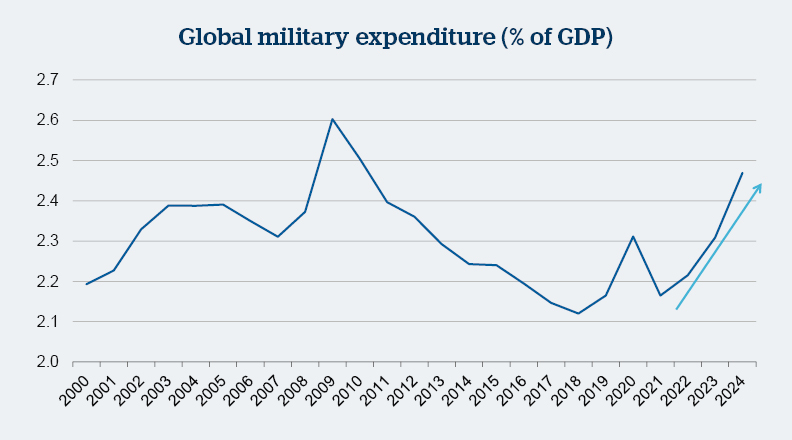
Source: World Development Indicators data as at 08 April 2026.
5. Supply & demand
Thanks to supply constraints, shortages have hit multi-year highs as existing stocks of rare earths and precious metals have been depleted. This has already resulted in massive price movements.
One of the enduring problems with mining is the long lead times it requires to bring additional supply to market. It can sometimes take 15 years or more to progress from discovery to delivery.
This makes mining an expensive business, replete with operational disruptions, the most challenging of operating environments, and never-ending scrutiny. Consequently, capital discipline has been paramount for success in the sector, with expansionary capital expenditure declining over the last decade while buybacks and dividends have increased.
Hence, while current supply shortages are at multi-year highs, they’re set to persist for many years to come, thanks to limited future supply growth. This is a portent of a new ‘super-cycle’ for mined commodities, something that’s evidenced by the recent boom in merger and acquisition activity in the sector.
Digging in…
When it arrives, the AI-driven world of tomorrow holds only one likely outcome for the mining industry; namely a massive rebalancing of the global economy that pushes the value of today’s industrial metals substantially higher.
Metals are required for every stage of the AI buildout, including its massive power requirements. And when the day comes that AI is creating greater economic output and greater profits across all industries, it won’t be today’s workers that receive the rewards. Many of them will have been replaced by AI-driven robotic systems. Meanwhile, competitive pressures will prevent the fathers of AI from enjoying the new profits generated in that type of economy. These will likely go to the owners of the remaining ‘scarce factors of production’, namely natural resource companies.
The value of investments and any income from them can fall and you may get back less than you invested.
Handelsbanken Wealth is a trading name of Handelsbanken Wealth & Asset Management Limited which is authorised and regulated by the Financial Conduct Authority (FCA) in the conduct of investment and protection business and is a wholly-owned subsidiary of Handelsbanken plc. Tax advice which does not contain any investment element is not regulated by the FCA. This document has been prepared by Handelsbanken Wealth for customers/potential customers who may have an interest in its services. The provision of this information does not constitute tax, pensions or investment advice.
Tax rates and legislation are subject to change. We cannot guarantee to inform you of any such changes and Handelsbanken Wealth accepts no responsibility for any inaccuracies or errors. Any levels of taxation referred to depend on individual circumstances and the value of tax reliefs are those which apply at 19 February 2026.
The value of the pension received when taking benefits from a pension will depend on various factors including, but not limited to, contributions made, charges and fees, tax treatments, annuity rates, investment performance. Professional advice should be taken before any course of action is pursued.
This does not constitute any recommendation to buy, sell or otherwise trade in any of the investments mentioned. Handelsbanken Wealth cannot accept responsibility for the consequence of any action taken or failure to take action by a reader on the basis of the information provided. When we provide advice in relation to investment, our own investment management services will usually be recommended. When advice on pensions or other products outside an investment management relationship is required, we will recommend products chosen from a limited selection of providers that have been appointed on the basis of its judgement in their quality of service, investor protection, financial strength and, if relevant, their financial performance. As a result, any advice given by Handelsbanken Wealth in respect of retail investment products will be restricted as defined under the FCA rules.
This document has been issued by Handelsbanken Wealth.
Registered Head Office: 25 Basinghall Street, London EC2V 5HA. Registered in England No: 4132340