Below, we outline some of our key views on the factors set to drive financial markets over the coming months, and what this means for our investment strategies.

What's next for the global economy and financial markets?

Revving up: US company earnings

While the war in the Middle East has now passed its 15th day – statistically the average low point in markets following similar geopolitical upheavals – it naturally continues to be the focus of great attention. This has obscured both the profound levels US company earnings growth now forecast for 2026, and the fact that this earnings growth is broadening out right across the US market.

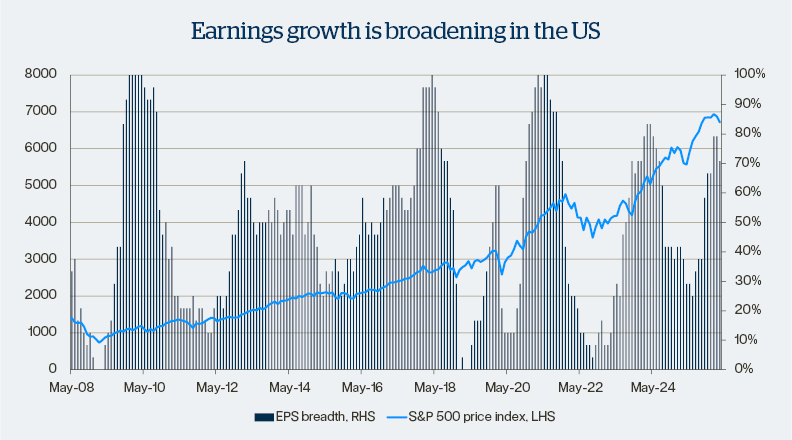
The latest forecasts from FactSet, show that earnings per share (EPS) growth for the S&P 500 Index of US companies has been substantially revised upward for the coming year. At the start of 2026, forecast EPS growth for the year ahead stood at 14%. It’s now expected to come in at a blistering 17% in the year to March 2027. Crucially for investors, over 70% of the S&P’s underlying industry subsectors are expected to see EPS acceleration this year (see this month’s chart).

Historically, when EPS growth broadens out like this, it’s provided a sustained boost for the market in question. This means that, unlike 2025, US market growth is no longer dependent on a small handful of mega-cap names.

Markets reverse direction as Iran war rages

Prior to the outbreak of the Iran war, US technology stocks, especially software companies, were on the backfoot. The software sector was down more than 30% from its high of late 2025. The Magnificent 7 (Mag 7), former darlings of the US stock market, had also struggled to gain traction.

At the start of 2026, investors were rotating into ‘old economy’, cyclical (meaning sensitive to the economic backdrop), smaller companies and value stocks. This favoured industrial, manufacturing, resources, energy and utility companies, at the expense of ‘new economy’ stocks exposed to the AI buildout. With tech stocks floundering, the broader US market also struggled due to its high weighting. This left the US in the dust over 2025 as investors favoured previously unloved regional markets such as the UK, Europe, Japan and emerging markets.

This rotation subsequently reversed with the onset of the Iran war. Since then, defensive, growth and energy stocks have flourished, as have US tech stocks. The Mag 7 has also been among the top performers while the US market is once again outperforming its peers, despite suffering losses.

UK gilts take hit from Iran war

UK government bonds, or gilts, have so far been one of the worst financial casualties of the Iran war. February’s solid gains were wiped away in March following the start of the Iran war, due to the risk it poses of a sustained, energy-driven inflation shock.

The ICE Bank of America Gilt index lost 4.8% in the first 20 days of March, putting gilts in negative territory for 2026, with the recent turmoil in the market being compared to that seen in the aftermath of the infamous Liz Truss mini-Budget crisis of 2022.

This has increased the cost of government borrowing and all but erased the UK Chancellor’s previous fiscal headroom of £20bn. At the time of writing, UK 10-year borrowing costs had already risen to an 18-year high, while the UK’s high-street lenders were increasing mortgage rates.

With gilt yields at historic highs (meaning their prices are at new lows) the market continues to be whip-sawed by President Trump’s changing rhetoric on the Iran war, a surprisingly ‘hawkish’ new tone from the Bank of England, and by the heavy presence of speculators unwinding their previous bets on UK rate cuts.
Our chart of the month

Chart Of The Month March 2026

Source: FactSet, Handelsbanken Wealth. Data as at 21 January 2026.

What this chart tells us?

The above chart shows how US company earnings growth (measured in earnings per share or EPS) is expanding, with over 70% of the underlying industry subsectors in the S&P 500 Index of US companies expected to see EPS growth in the year ahead.

Historically, this type of ‘broadening out’ in EPS growth provides a strong tailwind for any stock market fortunate enough to witness it.

The latest FactSet estimate for earnings growth in the S&P 500 Index stands at 17% for the year to March 2027. Even in a world where we still expect to see strong company earnings growth in the year ahead, especially in emerging markets, this figure stands out.

Scroll down the page to the sections below to find out what our market views mean for positioning in our investment funds.

  • So far, the first quarter of 2026 has been a story of two halves. The dividing line is the onset of the US/Israel war on Iran on 28 February.
  • The first half saw strong gains from stock markets outside of the US alongside solid progress for both government and corporate bonds (issued by companies), a weakening US dollar and a racing gold price. Markets were also expecting interest-rate cuts in the UK and US later this year.
  • The second half has seen a reversal of this picture. Global stock markets have declined with Europe and the UK suffering painful losses in response to fears of a second energy-induced spike in inflation. Since the outbreak of the Iran war, US shares have seen muted losses, but outperformed their peers with former winners such as Japan, Asian Pacific and emerging markets suffering significant losses, although they remain strongly ahead in 2026 (to 20 March).
  • Expectations of interest-rate cuts in the UK have evaporated. They have been replaced with fears of a potential hike later in 2026, while US rate cuts now seem a distant prospect.
  • The dollar has also strengthened as investors seek ‘safe havens’ from market volatility. This has benefitted US mega-cap stocks, in particular the Magnificent 7 cohort, while reversing the recent fortunes of the US software sector. It’s also helped to undermine the gold price. For sterling investors, gold plummeted by close to 12% in the first three weeks of March.
  • Fortunately, we came into the year with a view best described as ‘constructive, but not complacent’. We saw economic momentum building, inflation and interest rates abating and the prospect of strong US company earnings. We also saw the heightened geopolitical risks signalled by US actions toward Ukraine, Venezuela, Greenland and Iran.
  • The short-term outlook for stock markets now hinges on how long the Iran war persists, and specifically, how long the Strait of Hormuz, the world’s key supply channel for the petrochemical, liquified natural gas and fertiliser industries, remains closed. Any extended closure will have significant consequences for global growth and inflation.
  • Even so, we remain alert to the stock market opportunities created by the outbreak of war in the Middle East. If history is any guide, markets will quickly move on from the threats posed, and there are already tentative signs that President Trump has reached the limits of his current position.
  • Among our thematic holdings, our insurance exposure has so far rewarded, thanks to its defensive characteristics with the sector moving much in line with the broader S&P 500 Index of US companies, which has outperformed its international peers since the conflict began. Our biotech exposure has performed relatively well as the sector is fairly well insulated from geopolitical turmoil (although it’s sensitive to potential interest-rate hikes).
  • Elsewhere, our trend-following hedge fund has performed robustly so far this year, thanks to the increased market turbulence we’ve seen, while our purchase of a ‘put option’ in late 2025, that will pay out if stock markets suffer any further declines this quarter, now looks especially prescient.

Our stock market exposure

  • As at 23 March 2026, the Handelsbanken Wealth Balanced Multi Asset Fund, which sits at the mid-point of our portfolio range in terms of the balance between risk and reward, held 64.4% of its portfolio in company shares, which represented a small overweight compared to our long-term average weighting.
  • Within this, we remain underweight US stocks versus our long-term average, although it remains the largest regional exposure at 52% of total stock market exposure. Conversely, we are overweight to the stock markets of more economically sensitively regions, chiefly the UK and emerging markets.
  • We are underweight in Japanese companies, as we see more compelling opportunities elsewhere.

  • Prior to the onset of the Iran war, we had been reticent of further bond exposure as markets were transitioning from a period of synchronised interest-rate cuts from central banks to one of diverging rate decisions, which introduced an element of ‘two-way’ risk to bond markets. At the time, the UK and US were still expected to make further rate cuts unlike their peers in Europe and Japan.
  • With the onset of the Iran war, UK government bonds, or gilts, became an immediate casualty. February’s solid gains were erased in March, leaving gilts in negative territory for 2026. Although more muted, US government bonds (Treasuries) also sustained losses to be in the red for 2026 (to 20 March).
  • Most notably, interest-rate expectations have reversed course since war broke out in the Middle East. Prior to the hostilities, markets were expecting two UK interest-rate cuts this year. This has been replaced with the expectation that interest rates might need to rise this year as the UK imports another round of fuel price inflation.
  • Expectations of US rate cuts have also been pushed a long way back, with all four major central banks pointing to the inflation risk posed by the current crisis in the Gulf at their recent March meetings. All four also kept interest rates on hold.
  • Because inflation was already higher in the UK than in the US, and because the US is the world’s largest energy exporter and so mostly self-sufficient in terms of its energy needs, US Treasuries have so far sustained less damage than UK gilts.
  • At the time of writing, UK 10-year borrowing costs had risen to an 18-year high, while the gilt market continued to be whip-sawed by President Trump’s changing rhetoric on the Iran war and by a new, surprisingly ‘hawkish’ tone from the Bank of England.
  • Bond markets will remain under pressure so long as the spectre of another energy-driven inflation spike persists. This could be some time considering the effort it will take to restore global supply lines, and so ease inflation pressures, even if the war comes to an early end.
  • Since the start of the Iran war, bonds have demonstrated relatively few diversification benefits. However, yields for government bonds – especially gilts – now stand at attractive levels meaning they offer attractive future income streams, and greater diversification benefits going forward.

Our bond market exposure

  • As at 23 March 2026, the Handelsbanken Wealth Balanced Multi Asset Fund held 24.4% of its portfolio in bonds. Within this, 9.1% was in government bonds which was an underweight relative to our long-term average weighting. We reduced our overweight to UK government bonds prior to the outbreak of the Iran war. This took us back to a ‘neutral’ weighting (meaning it was much in line with our long-term average weighting).
  • The fund also held 10.2% in higher-quality, investment-grade corporate bonds (issued by companies) with a 3.3% weighting to higher-yielding bonds of lower credit quality. This represented a slight underweight compared to our long-term average weighting.
  • The fund’s small position in emerging market bonds was in line with our long-term average weighting.
  • Following the significant fall in UK gilt prices, we decided to take advantage of the value on offer by adding back to our holdings once more, moving us from ‘neutral’ back to being marginally ‘overweight’ (compared to our long-term average).

The ‘alternative’ investment space covers an enormous universe of competing strategies and asset classes from commodities and commercial property to specialist hedge funds that employ a diverse spectrum of strategies. Consequently, broad statements as to our view on the market as a whole are redundant.

In the alternatives space we hold only gold, a select group of hedge fund strategies, and a small position in commercial property.


  • Although we’re broadly ‘underweight’ to alternatives, relative to our long-term average weighting, we have significant positions in gold, hedge funds, and a small but growing exposure to property assets where we’ve recently been reducing our underweight.

  • We hold gold as the best means to ‘hedge’ geopolitical risks. Although the gold price surged due to earlier geopolitical events in 2026, it sold off sharply following the start of the Iran war (to 20 March) as investors booked profits. We would expect to see gold’s safe-haven characteristics reasserting themselves, and demand returning, in response to today’s heightened geopolitical tensions.

  • We hold hedge funds to protect us from violent market disruptions by providing returns with a low correlation to the movement of stock and bond markets.

  • We recently increased our global property exposure from ‘underweight’ to ‘neutral’ on the basis that such assets should benefit from the improving economic backdrop. However, the potential for rising interest rates caused by an energy-driven spike in inflation will impact the prospects for real-estate assets.

Our alternatives market exposure

  • As at 23 March 2026, the Handelsbanken Wealth Balanced Multi Asset Fund held 10.7% of its portfolio in alternative asset classes intended to deliver diversification from its stock market and bond holdings.
  • Our exposure to gold constituted just over 40% of this weighting with our specialist hedge fund positions and our small exposure to property accounting for the rest.
  • For the Balanced Multi Asset Fund this represented a slight underweight compared to our long-term average weighting.

If you’d like further information on how we divide investments in our strategies across different types of assets (i.e. our asset allocation framework, and our tactical deviations away from it), please contact us.

Important Information

Handelsbanken Wealth is a trading name of Handelsbanken Wealth & Asset Management Limited which is authorised and regulated by the Financial Conduct Authority (FCA) in the conduct of investment and protection business, and is a wholly-owned subsidiary of Handelsbanken plc. For further information on our investment services go to wealthandasset.handelsbanken.co.uk/important-information. Tax advice which does not contain any investment element is not regulated by the FCA. Professional advice should be taken before any course of action is pursued.

All commentary and data is valid, to the best of our knowledge, at the time of publication. This document is not intended to be a definitive analysis of financial or other markets and does not constitute any recommendation to buy, sell or otherwise trade in any of the investments mentioned. The value of any investment and income from it is not guaranteed and can fall as well as rise, so your capital is at risk.

We manage our investment strategies in accordance with pre-defined risk objectives, which vary depending on the strategy’s risk profile.

Portfolios may include individual investments in structured products, foreign currencies and funds (including funds not regulated by the FCA) which may individually have a relatively high risk profile. The portfolios may specifically include hedge funds, property funds, private equity funds and other funds which may have limited liquidity. Changes in exchange rates between currencies can cause investments of income to go down or up.

This document has been issued by Handelsbanken Wealth. For Handelsbanken Multi Asset Funds, the Authorised Corporate Director is Handelsbanken ACD Limited, which is a wholly-owned subsidiary of Handelsbanken Wealth, and is authorised and regulated by the Financial Conduct Authority (FCA). The Registrar and Depositary is The Bank of New York Mellon (International) Limited, which is authorised by the Prudential Regulation Authority and regulated by the FCA. The Investment Manager is Handelsbanken Wealth, which is authorised and regulated by the FCA.

Before investing in a Handelsbanken Multi Asset Fund you should read the Key Investor Information Document (KIID) as it contains important information regarding the fund including charges and specific risk warnings. The Prospectus, Key Investor Information Document, current prices and latest report and accounts are available from the following webpage: wealthandasset.handelsbanken.co.uk/fund-information/fund-information/, or you can request these from Handelsbanken Wealth or Handelsbanken ACD Limited: 25 Basinghall Street, London EC2V 5HA or by telephone on 01892 701803.

Registered Head Office: 25 Basinghall Street, London EC2V 5HA. Registered in England No: 4132340

You may also be interested in

View all articles

Weekly Bulletin

Markets search for clues on Iran

Insight

Always looking for long-term opportunities

Weekly Bulletin

Few places to hide for investors

Investment Update

Quarterly Investment Update - January 2026

